
In short
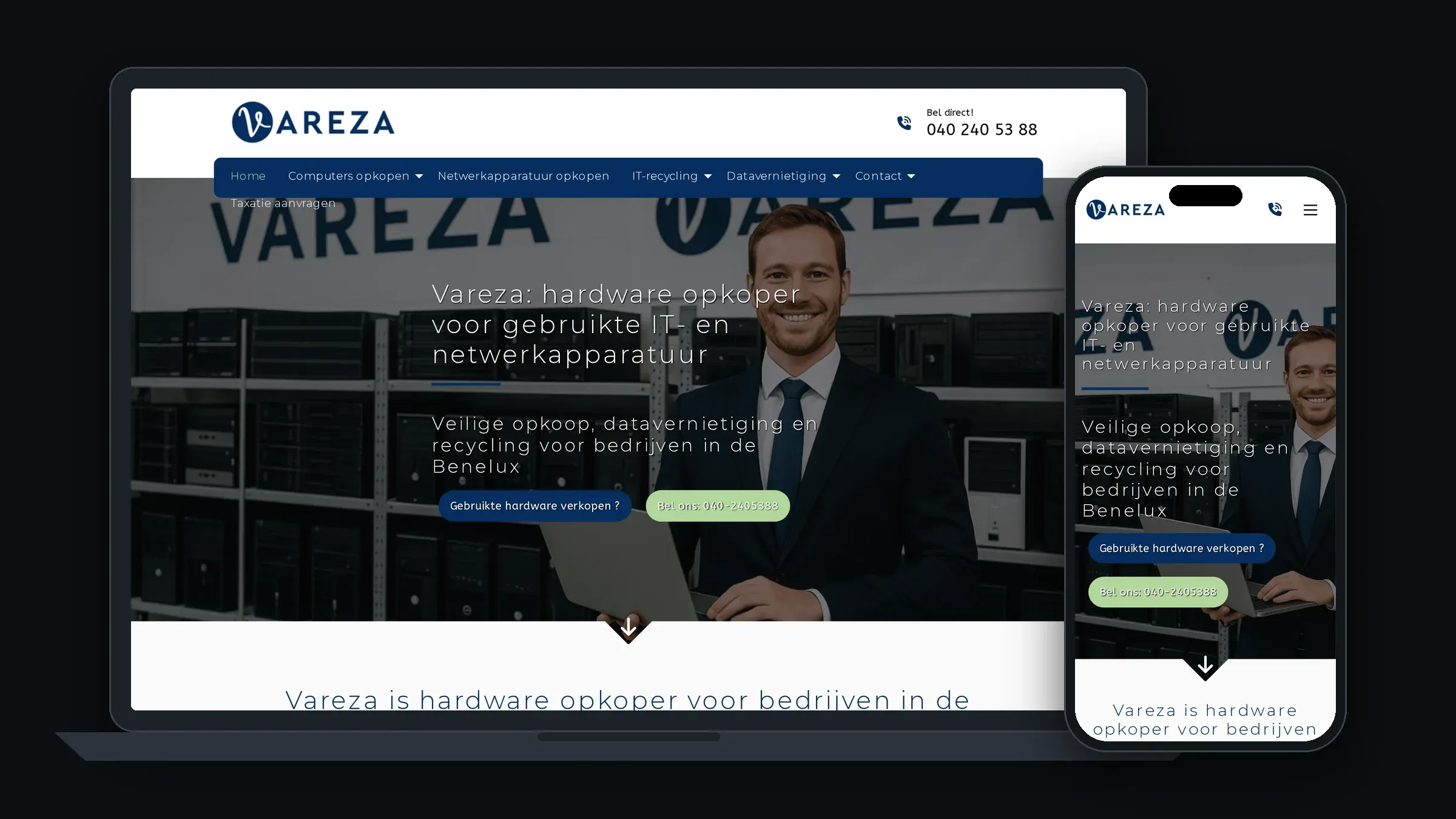
Vareza buys used business IT hardware and recovers its residual value, with recycling and data destruction handled by certified partners. The site got plenty of impressions in Google but few visitors, and had almost no explanatory content for AI systems to cite. I cleaned up the site, sharpened existing pages and built three new pages on proof and documentation when disposing of IT. Every claim on those pages was checked against how the client actually works, and the changes are measured in Search Console.
Facts at a glance
| Client | Vareza (vareza.nl) |
|---|---|
| Sector | B2B, buying used business IT hardware, the Netherlands and Belgium |
| Period | From July 2026, ongoing |
| Disciplines | SEO, GEO, content, strategy |
| Technology | WordPress, Yoast SEO, ACF, Redirection, Search Console, Semrush |
| Status | Live, ongoing |
About the client
Vareza buys servers, network equipment, laptops and desktops from businesses. It collects across the Netherlands and Belgium and only works with companies. Recycling and data destruction run through certified partners; Vareza coordinates. That distinction matters, because the audience is exactly the kind of buyer who checks claims.
The question
Vareza wanted more enquiries from Google. The client also wanted to show up in answers from ChatGPT, Perplexity and Google AI Overviews (GEO: visibility in AI answers). There was one firm condition: the positioning stays buying and residual value. Not an IT lifecycle provider, even though customers do search for that term.
Where it started
I started with an audit and a Search Console analysis. Three things stood out.
The site was not too narrow but too shallow. Many pages showed up, but the main keywords mostly ranked between position 15 and 35. That gets you impressions, not clicks.
There were 93 overlapping blog posts. Seventy-three of them had zero impressions between 8 June and 7 September 2026 (Search Console). I first checked that they were actually live: all 93 returned a normal HTTP 200.
The site had almost no explanatory content. Informational searches made up 0.7 percent of impressions between 16 May and 15 August 2026 (Search Console). That is exactly the content AI systems use as a source.
What I did
Cleanup
I merged pages that competed with each other using 301 redirects (permanent redirects). Tag, category and author archives were set to noindex (kept out of Google). On 25 pages I aligned the text about collection with the client’s own wording, with the condition in the same sentence. For the 93 blog posts I made a recommendation per post: keep, merge or take offline. That proposal is with the client; nothing goes offline without approval.
Sharpening existing pages
The server page ranked 18.4 for the Dutch term for “buying servers” but never used those words. I added the exact term to the text and linked to it from stronger pages. I deliberately left the title alone. Change title and text at once, and you cannot tell afterwards what made the difference.
Three new pages on proof
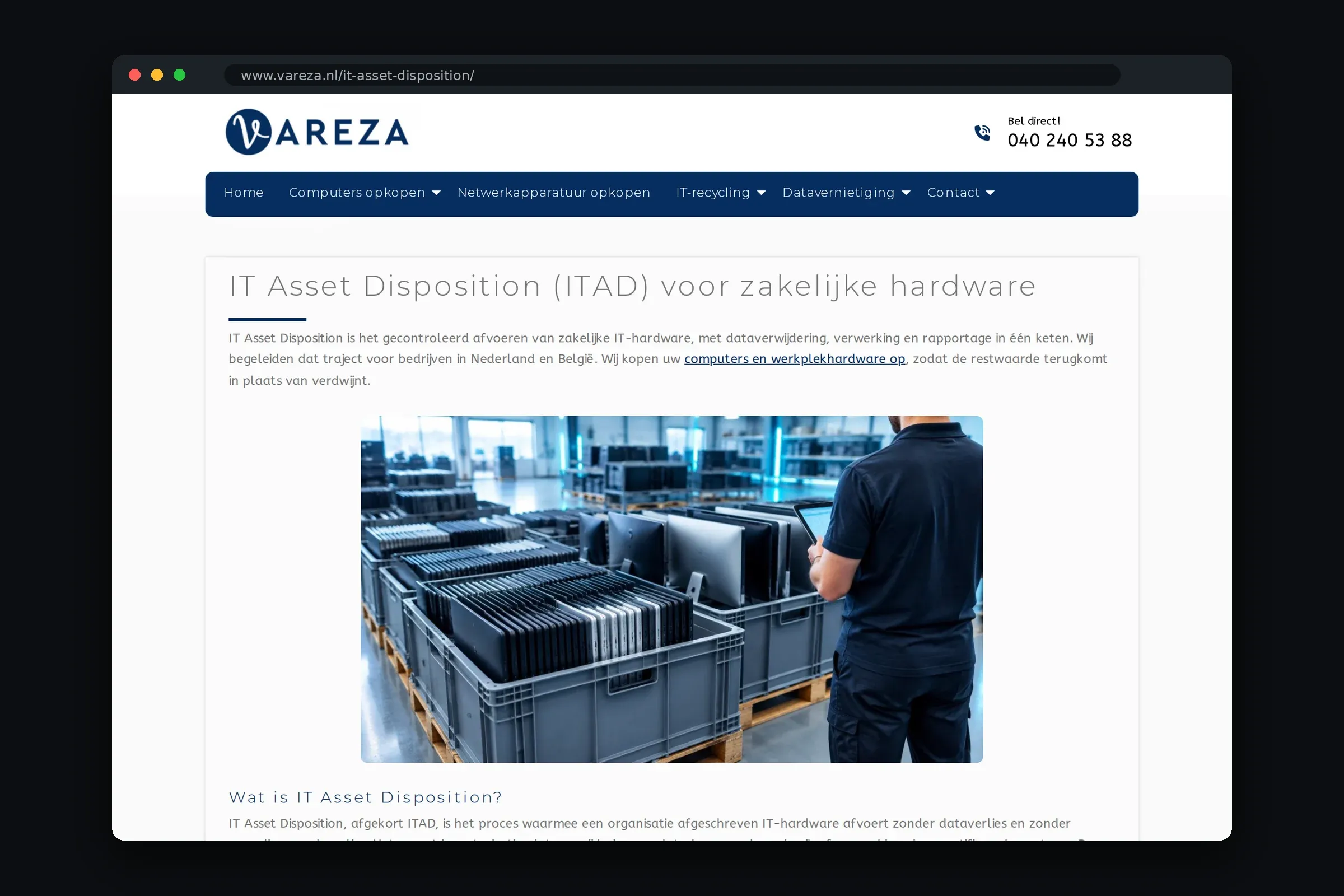
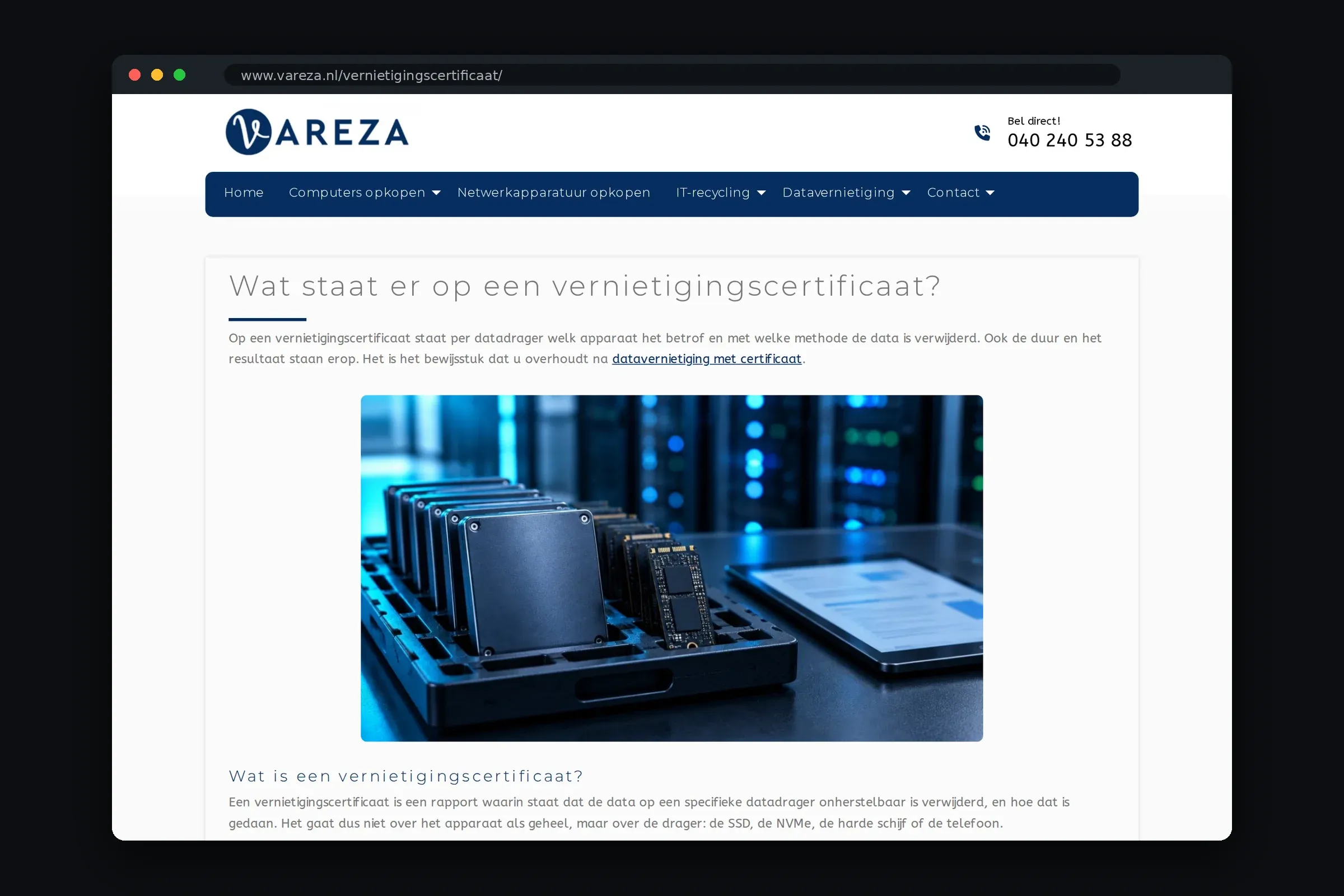
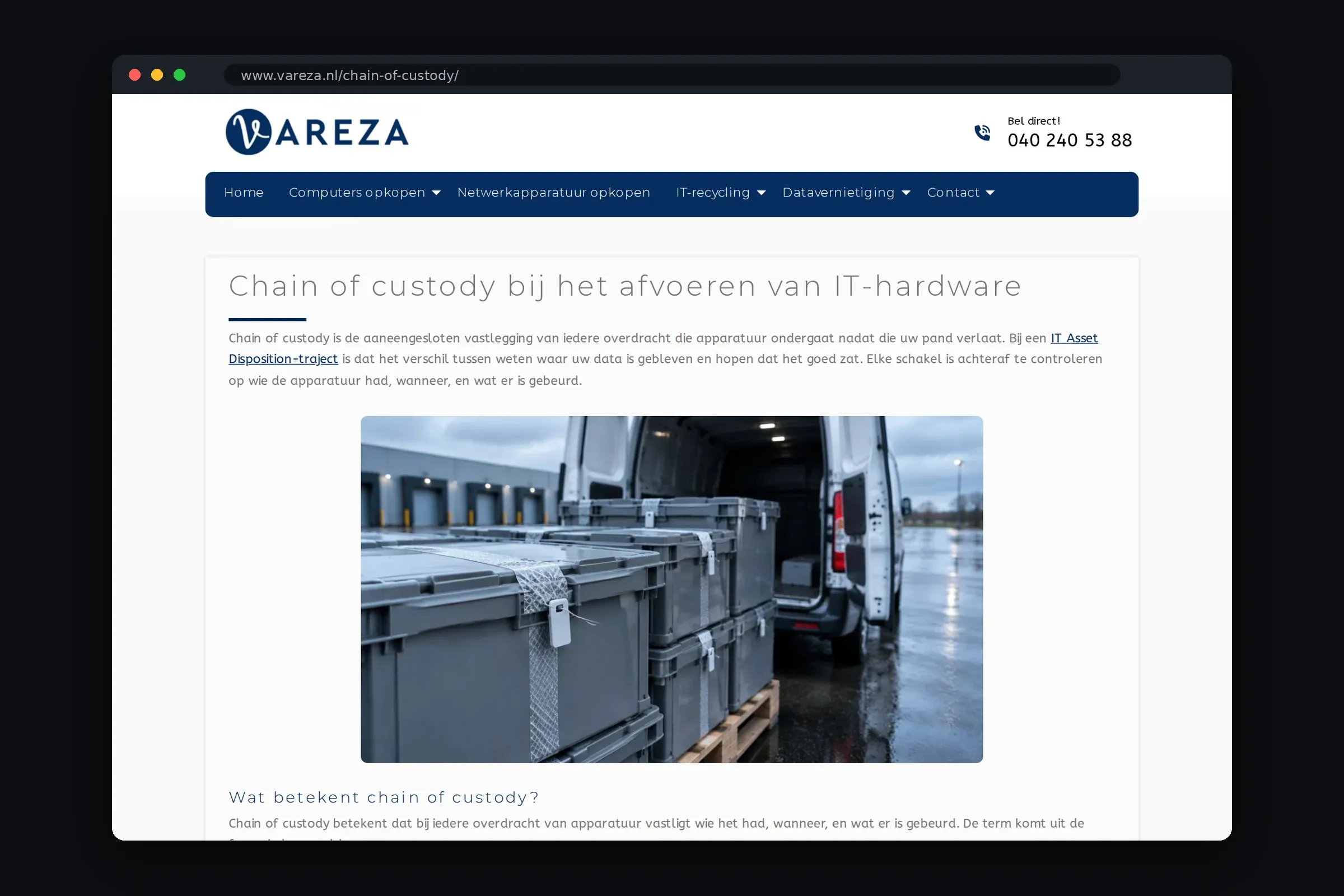
I wrote and published three pages: IT Asset Disposition, the certificate of destruction and chain of custody (the recorded chain from collection to processing). Each page got schema (structured data for search engines) with an FAQ, its own image and internal links. The ITAD page catches the industry term and moves to buying within two sentences. The content comes from real jobs, anonymised and approved in writing by the client.
Files for AI crawlers
I updated llms.txt and llms-full.txt (text files that give AI systems a summary of the site). They are ready to be placed through the hosting.
How I checked it
Claims against the source. After writing the three pages I ran three separate reviews: facts against the client’s notes, compliance and style rules, and language. That produced 4 blocking and 12 important findings, all of which I fixed. One blocking finding: a sentence suggested Vareza wipes drives itself. The partners do.
Wording across the whole site. Which wiping standard applies depends on the job and the partner. Once that was clear, I added the second standard next to the first on nine pages. Then I counted on each live page whether both standards appeared equally often, in the text and in the schema.
Technical checks after every change. After publishing I check the live page, not the editor. Every schema block must be valid JSON. If it is not, I do not save it. A check of all 128 published pages and posts found no internal link pointing to a 404.
Measuring with fair windows. To judge a change I compare two equal periods that do not overlap, on either side of the change date. Overlapping three-month windows hide a two-week-old change.
Results
Source: Search Console, 20 to 31 August compared with 1 to 12 September 2026.
- Average position for the whole site: from 28.6 to 25.8.
- Impressions: about 16 percent lower. That fits the cleanup: weak impressions drop away.
- Clicks: unchanged across both periods.
- “it recycling”: from position 9.5 to 7.4.
The text change on the server page had no demonstrable effect in that period. About one and a half places on few impressions is noise.
The three new pages have been live since 14 September 2026 and are too new to measure.
What happens next
The work continues with a fixed round each quarter. The measurement shows that the bottleneck is the click threshold, not the number of topics. So I am focusing on improving existing rankings, measured monthly.
Frequently asked questions
Why not just write more new pages?
Because the site already had plenty of impressions, but in positions nobody clicks. Twelve new pages at position 30 do little. Lifting a few existing pages over the threshold does more.
How do you stop an AI answer from repeating a wrong promise about your business?
Put the condition in the same sentence as the promise, and make no claims you cannot back up. That is why Vareza’s site says throughout that certification runs through partners, not Vareza itself.