
In short
Zorgboerderij Annabelle is a small care farm in Westerhoven, in the south of the Netherlands. It offers day activities, residential care around the clock and one-to-one support for up to fifteen clients a day. The goal was not more traffic, but three to five suitable enquiries a month from families and referring professionals. I measured the starting point, built a funding information page and schema markup, made the contact form actually deliver messages and audited how Google indexes the site. The site is live and the project is ongoing.
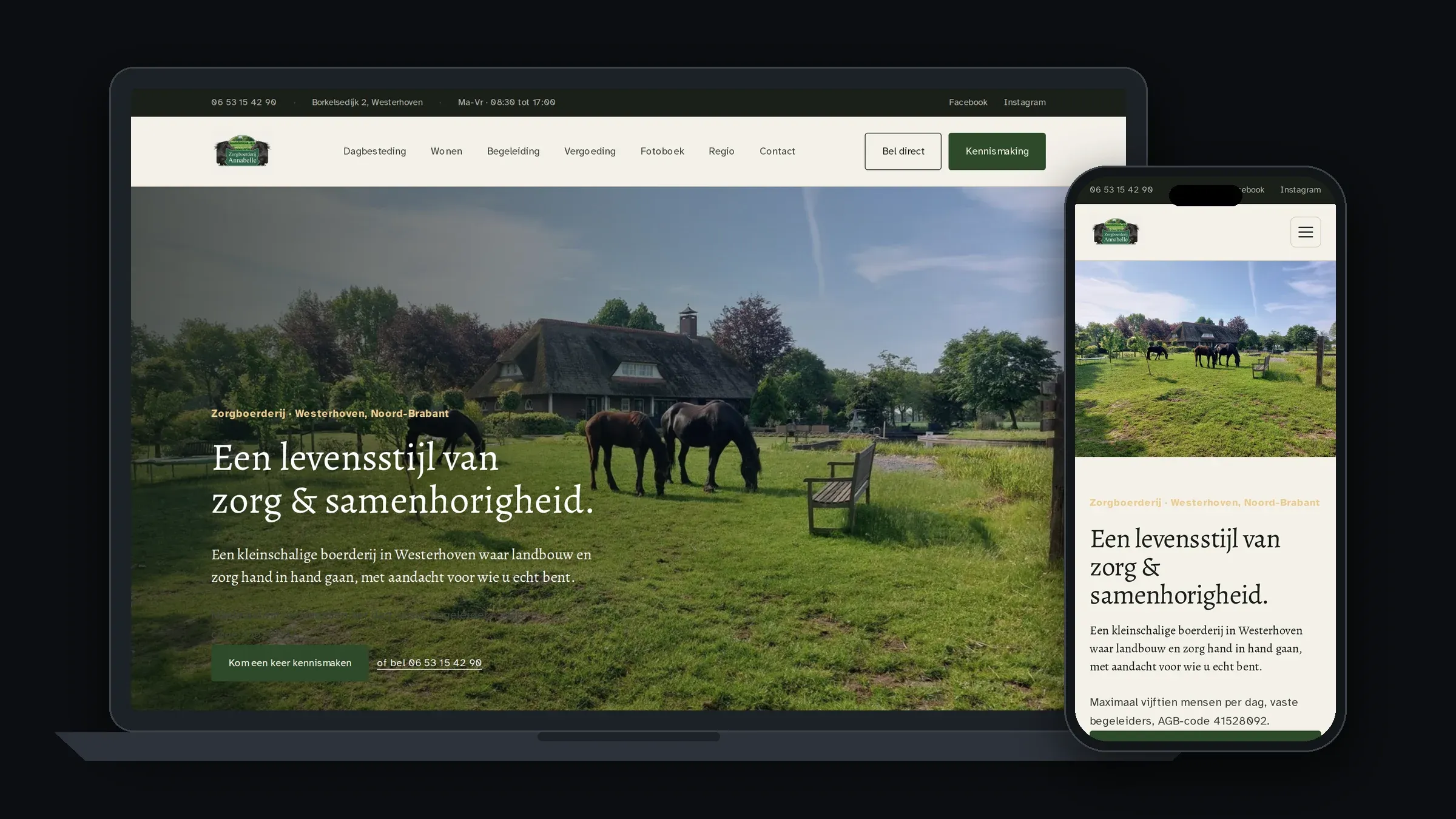
Facts at a glance
| Client | Zorgboerderij Annabelle, Westerhoven (NL) |
|---|---|
| Sector | Care (day activities, residential care, support) |
| Period | September 2026, ongoing |
| Disciplines | SEO, GEO, web development, content, strategy |
| Tech | Static HTML, PHP, JSON-LD, Search Console, Semrush |
| Status | Live, next steps in progress |
About the client
Annabelle is a small care farm in the municipality of Bergeijk, North Brabant. It works with a fixed team and takes up to fifteen clients a day. The care farm belongs to my parents. I mention that here so you can weigh this case accordingly. Care is funded through Dutch public schemes: the WMO (via the municipality) or the WLZ (via the regional care office). Clients arrive in two ways: a relative searching online, or a professional such as a municipal care consultant or dementia case manager who refers them.
The brief
The farm has places for day activities, residential care and support, and they need to go to people who are a good fit. With a handful of enquiries a month, quality beats volume. So the site had two jobs: reassure families, and let a referrer see quickly whether someone belongs here.
Where things stood
I started with a baseline in Semrush (Dutch database, September 2026). The site ranked for 17 keywords. It ranked first for its own name and sixth for “zorgboerderij eindhoven” (care farm Eindhoven). For two search terms, several of its own pages were competing with each other (cannibalisation). None of the regional pages ranked for anything. While reading through the code, I also found that the contact form showed a thank-you message but never sent the message anywhere.
What I did
Measure first, then decide
I looked at the search results for the main terms one by one. For “care farm Eindhoven”, Google mostly shows the homepages of providers and a few directories. A separate city page has little chance there, so I chose not to build one. The same goes for “day care dementia”: 480 searches a month, but the top ten is national information sites. That is not a race worth running.
Content for families and referrers
I wrote a funding page that explains each route: WMO, WLZ and a personal budget, with the personal contribution and its source. The homepage still had sentences that contradicted it; those were replaced. The menu is now the same on every page, internal links were added and the sitemap was updated. A separate page for referrers is being prepared. It deliberately stays out of the main menu, so the path for families stays calm.
Technical structure
I wrote schema markup (code that tells search engines and AI systems who an organisation is) for every page. It includes the address, the chamber of commerce and healthcare provider codes, and the three services, all linked together. I deliberately left out star ratings, because Google does not allow them for self-collected reviews. The contact form now sends through a PHP script on the site’s own server. I ruled out an external form service: enquiries describe people’s health, and that data stays on the client’s own server.
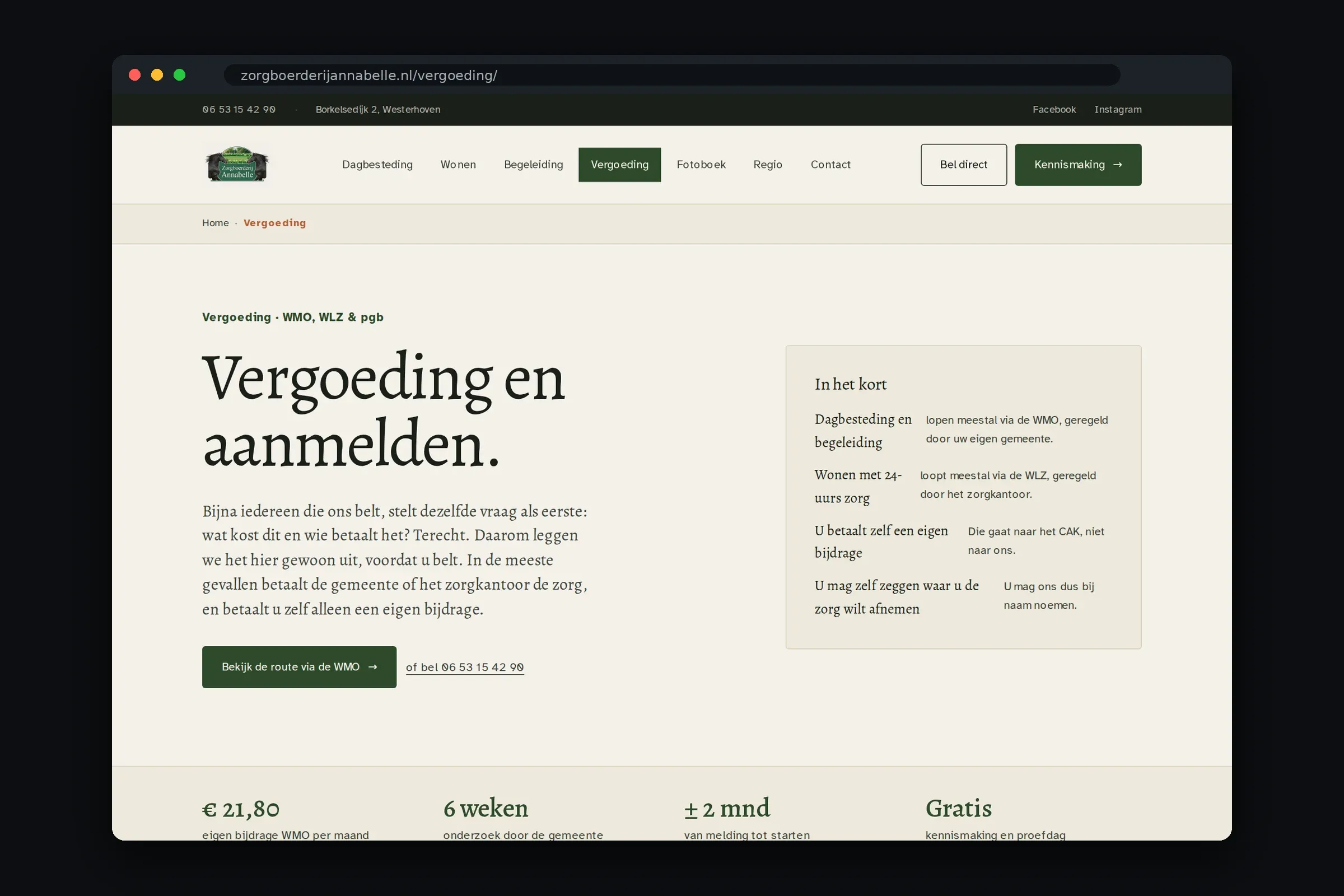
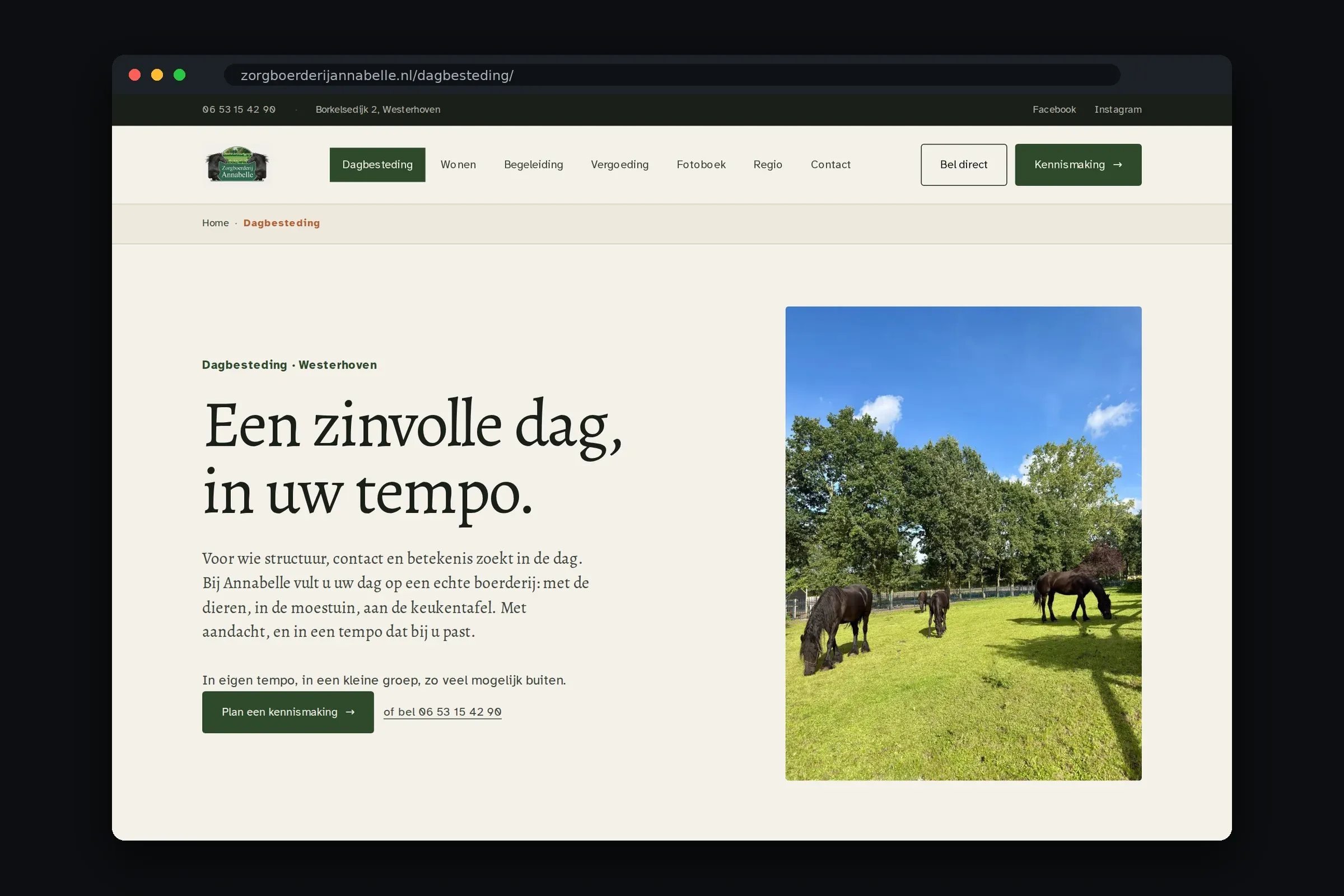
How I checked it
- Search Console, page by page. On 22 September 2026 I inspected the pages one by one. Of the 14 pages in the sitemap, 6 were not in Google, including the support page and all four regional pages. Google listed four of them as “unknown”. That explained at once why the Eindhoven page never ranked: it was not indexed.
- The live source code. On 23 September 2026 I pulled and read the source of the live pages. The homepage, the day activities, support and funding pages and the Eindhoven page carry schema markup. The old funding sentences are gone from the homepage. The form script refuses anything but a real submission.
- Schema markup. On 23 September 2026 I read the schema markup on the homepage and the day activities, support and funding pages. Every block is valid JSON-LD.
- Design audit. I reviewed the site at 1440 and 390 pixels wide, including the CSS. The grey text colour scored a contrast of 4.07 against a standard of 4.5. During the audit I also found I had mistaken an outdated CSS rule for the real spacing, and corrected that in the report.
- Fixed measurement points. I measure again after 4 and 12 weeks, with the same keywords in the same database. For AI visibility, a set of 14 fixed questions is ready for ChatGPT, Perplexity and Google AI Overviews.
Results
There is no measured effect yet, because the first re-measurement is still scheduled. The baseline is fixed: 17 keywords (Semrush, September 2026). What is live now: a funding page with sources, schema markup on the main and regional pages, a menu and internal links that match everywhere, and a contact form that sends through the site’s own server.
What comes next
First, getting the six missing pages into Google. Then the referrer page, the Google Business Profile with reviews and a listing on ZorgkaartNederland, the main Dutch care review site. The AI baseline and the 12 week re-measurement will show what has moved.
Frequently asked questions
Is SEO worth it for a care provider with only a few places?
Yes, if you measure the right outcome. For Annabelle the goal is three to five suitable enquiries a month. So I look at visibility for the brand name, the region and the questions referrers ask, not at maximum traffic.
Why not a page for every town in the region?
Because the search results show that for “care farm [town]” Google mostly shows the providers themselves. I only build regional pages that have real content, and I check first that they are indexed.
Why not use a form service like many websites do?
Because families often write about a relative’s health in an enquiry. So that data stays on the site’s own server.